
What we are calling for
- A federal life sciences industrial strategy developed in partnership with the sector, including hospitals, health authorities and health research organizations.
- Explicit recognition of hospitals, health authorities and health research organizations as enabling infrastructure for commercialization, clinical trials, procurement, technology adoption, talent development and domestic scale-up
- Long-term CIHR funding for national clinical trials platforms, coordination, shared tools and infrastructure
- A national start-up standard requiring trial sites to begin enrolling patients within 75 days of a Health Canada Clinical Trial Application
- Targeted investments in clinical trials teams, equipment and tools at hospitals, research institutes and networks, including community, rural and Northern sites
Member stories

In 2021, University Health Network highlighted a Canadian-led, world-first gene therapy breakthrough for Fabry disease, showing how hospital-based research can move from discovery to patient care. Building on years of work at UHN’s Princess Margaret Cancer Centre, researchers advanced a treatment using a patient’s own blood stem cells to help produce the missing enzyme responsible for the disease. The results point to the power of research hospitals to bridge discovery, clinical trials and better outcomes for patients.

In 2025, Vancouver Coastal Health Research Institute highlighted a clinical trial using wearable technology and machine learning to improve medication management for people living with Parkinson’s disease. Through the PD Sweat OFF trial, researchers are testing whether smartwatch data can help predict when medication is wearing off before symptoms return. The study shows how health research institutes are turning emerging digital tools into real-world clinical applications that support more personalized, patient-centred care.

In 2026, The Ottawa Hospital Research Institute highlighted an international study showing a more efficient way to rule out deep vein thrombosis in older adults. Led by Dr. Grégoire Le Gal, the study found that using an age-adjusted D-dimer cutoff can reduce unnecessary ultrasounds and blood thinners without compromising patient safety. The findings show how hospital-based research can improve care, ease pressure on busy emergency departments and support more personalized, evidence-based medicine.
What we are calling for
- Make health a priority pillar within Canada’s AI and digital policy agenda
- Invest in digital infrastructure and secure, localized data capacity
- Establish regional AI and digital health innovation hubs anchored in hospitals, research institutes and academic health science centres
- Create practical pathways to test, validate, procure and scale proven technologies across jurisdictions
Member stories

Nova Scotia Health’s Health Innovation Hub brings together clinical champions, industry, foundations, governments and academic partners to move health innovation from idea to impact. Its strengths include deep regional research partnerships, mature data and digital infrastructure, alignment with provincial policy and a proven ability to validate and scale solutions, including the CAN Health Network-supported Virtual Hallway pilot that expanded across Nova Scotia and into Atlantic Canada. The hub is also advancing AI-enabled care through projects like the Care Coordination Centre, a province-wide command centre that uses real-time data to help teams manage care more quickly and efficiently.

CIUSSS West-Central Montréal, anchored by the Jewish General Hospital, is using its role as an integrated university health and social services network to serve as a real-world living lab for health innovation. Through OROT, its Connected Health Innovation Incubator, the organization brings together patients, providers, industry and academic partners to co-design, test, evaluate and scale AI-enabled and digital health solutions across the full continuum of care. Projects in development include digital vital-sign monitoring that can automatically document patient data, saving clinicians time and creating more capacity for care.

CHEO Research Institute is spearheading CORE Innovation, a 10-hospital partnership in Eastern Ontario designed to move health technologies from invention to adoption. Powered by AI compute, AI expertise and health technology incubators, the initiative helps partners define real-world care challenges, test home-grown solutions and create pathways for scale. One example is The Ottawa Mask, a reusable, rigorously tested mask developed through collaboration that has sold more than 15,000 units.
What we are calling for
- A 10-year federal capital health infrastructure program with predictable funding, front-loaded to deliver the greatest impact in the first five years
- Dedicated funding streams for both physical and digital infrastructure
- Investment in physical infrastructure, including emergency departments, surgical suites, imaging, inpatient beds, mental health and addictions facilities, primary care and team-based care spaces
- Investment in digital infrastructure, including interoperability, secure connectivity, cybersecurity and data platforms
- Dedicated support for rural, remote and Northern connectivity to improve access to virtual care, remote monitoring, shared diagnostics and secure data exchange
Member stories

A state-of-the-art critical care centre at Sunnybrook Health Sciences Centre
Sunnybrook Health Sciences Centre is building on its origins as a military hospital to create a new critical care centre that will serve both military and civilian populations. The redevelopment will replace aging infrastructure with more than 400 new critical care beds, a new helipad, advanced surgical and radiology suites, and a virtual command centre to support care coordination across Ontario. The project shows how modern health infrastructure can expand capacity, strengthen emergency and critical care and support a growing and aging population.
Modernizing the Queen Elizabeth II Health Sciences Centre
The Halifax Infirmary Expansion Project will replace aging infrastructure and expand access to modern acute care for Nova Scotians and Maritimers. Led through a partnership between Nova Scotia Health, the Government of Nova Scotia and Build Nova Scotia, the project includes a new acute care tower with 216 beds, 16 operating rooms, a 48-bed ICU, a larger emergency department, upgraded labs, diagnostic imaging and specialized treatment spaces. The expansion shows how modern health infrastructure can increase capacity, support more advanced care and replace facilities nearing the end of their life span.

Health Sciences Centre Winnipeg is undertaking a $1.5-billion reconstruction of its adult bed towers to replace aging infrastructure, with some facilities dating back more than a century. The project will create 240 modern private rooms, add space for procedure rooms and diagnostic imaging, and expand the adult emergency department to improve patient flow and infection prevention and control. The redevelopment shows how modern health infrastructure can support better care, strengthen workforce recruitment and retention, and help train the next generation of health professionals.
What we are calling for
- Consistent pan-Canadian workforce data collection
- Integrated workforce modeling and planning
- Faster entry and licensing for internationally educated health professionals
- Fewer barriers to worker mobility across Canada
- Better alignment between education, training and workforce need
- Federal action to address violence in health workplaces and support worker well-being
- Upskilling of managers to be ‘future ready’ and to support system transformation
Addressing Workplace Violence against Healthcare Workers
In 2019, the federal Standing Committee on Health tabled a report on violence facing healthcare workers with nine recommendations including an amendment to the Criminal Code to require a court to consider the fact that the victim of an assault is a healthcare work in sentencing.
In 2022, in response to rising violence in health settings related to the pandemic, the federal government passed Bill C-3, allowing courts to consider more serious penalties for offenders who impede healthcare workers from their duties. Recently, however, the Secretary of State for Combatting Crime herself said in the House of Commons that the law is not being adequately enforced.
Today, violence against healthcare workers has reached a crisis point. The ripple effects are being felt throughout the whole health system. It is important for policymakers to take critical accountability to deter violence from happening to the people who provide care to Canadians.
Bill S-233 ensures the perpetrators of violence against a healthcare worker will face more consequences for their actions. The bill is currently making its way through the House of Commons. HealthCareCAN is urging the federal government to pass Bill S-233 and protect the people who care for Canadians.
Member stories
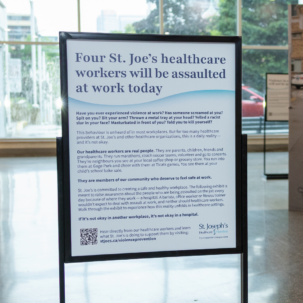
Preventing violence against healthcare workers
St. Joe’s Health System reported a nearly 30 per cent increase in violent incidents against healthcare workers in the last year. Some healthcare workers experience violence from patients nearly every single shift. To call more attention to the increase in violence, St. Joe’s launched a campaign featuring its own staff sharing real-life stories of the violence they experience on the job. St. Joe’s is committed to working with staff, patients, visitors, and community to provide a safe place to work and has also increased security personnel, security cameras, and panic alarms, and enhanced safety training. St. Joe’s is actively advocating with the federal government to expeditiously pass Bill S-233 to keep healthcare workers safe from harm.
⇒ Listen to the experiences of healthcare workers at St. Joe’s here and learn how you can help. ⇐
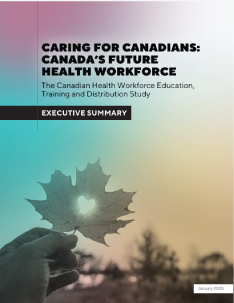
The Canadian Health Workforce Education, Training and Distribution Study highlights the scale of Canada’s health workforce challenge across key professions. The study found current gaps of nearly 23,000 family physicians, 28,000 registered nurses, 14,000 licensed practical nurses and 2,700 nurse practitioners, alongside shortages in psychiatric nursing, occupational therapy, physiotherapy and pharmacy. These findings reinforce the need for coordinated action to expand training capacity, improve workforce distribution and ensure Canadians can access the care they need.