Funding Sources of Canada’s Hospital-Based Research & Innovation
A Preliminary National Picture of HealthCareCAN Member Research Funding and Revenue*
Canada’s hospitals, health authorities and health research institutes are where discovery becomes care and where public science becomes economic opportunities. These institutions run clinical trials, validate new technologies, train highly qualified personnel and turn health data into evidence.
This report presents a preliminary national picture of research funding and revenue across HealthCareCAN’s membership and underscores one central point: hospital-based research is a distinct national research and innovation enterprise, with its own strengths, opportunities and needs, and should be recognized and supported accordingly through federal policy and investment.
Members funding calculations and reporting mechanisms are varied across the sector; this means the collective scale of researching funding and revenue has never before been rolled up into one cumulative calculation. Treated as a collection of projects rather than a collective research sector in its own right, hospitals, health authorities and health research institutes combined role in delivering federal research, health, economic and life sciences objectives is overlooked. This report begins to close that gap.
A $4.9 BILLION ENGINE AT WORK
We’ve identified approximately $4.9 billion in research funding and related revenue across HealthCareCAN members.
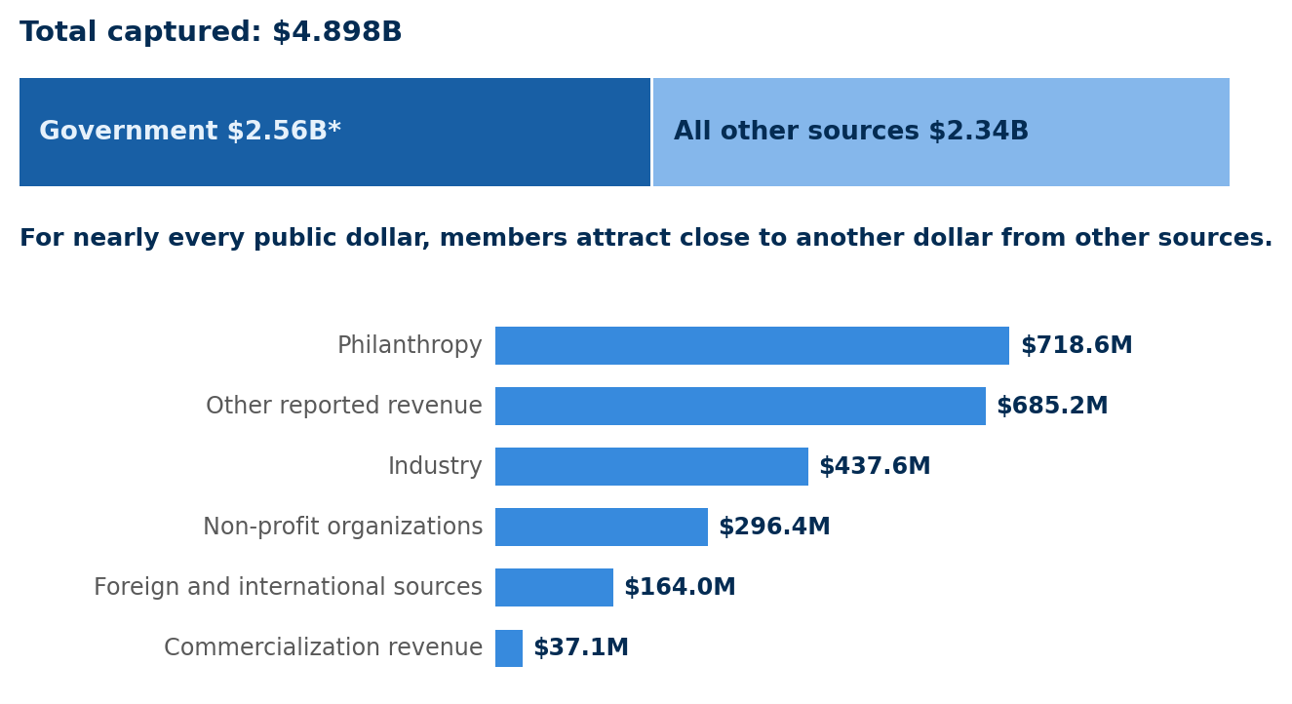
*Government funding combines amounts reported as federal, provincial, combined federal/provincial and other government support. The available sources did not consistently separate funding by level of government.
This is not a collection of isolated budgets. Taken together, HealthCareCAN’s members are a distributed national engine that brings researchers, clinicians, patients, health data and investment together in environments directly connected to care. Through these healthcare institutions discoveries move from testing to validation to adoption to patient benefit within the same ecosystem. Independent reporting confirms the scale. Research Infosource’s 2025 ranking of Canada’s top 40 research hospitals totals approximately $3.82 billion in FY2024 research spending.
This figure is preliminary and certainly understates the total real funding and revenue. Comparable financial numbers were not available for every organization and some funding is recorded by affiliated entities. Scale also does not mean sustainability: much of this funding is tied to specific grants that do not cover the personnel, equipment, data systems and trial infrastructure needed to deliver them.
PUBLIC INVESTMENT THAT GOES TWICE AS FAR
Approximately $2.56 billion, or 52% of the total captured, came from government sources. This public investment is catalytic: it builds the research teams, facilities, data capacity and credibility that help members attract $718.6 million in philanthropy, $437.6 million from industry, $296.4 million from non-profit organizations and $164.0 million from foreign and international sources. For nearly every public dollar identified, members secured almost another dollar from other sources. Federal investment in hospital-based research does not displace other funding; it draws it in, positioning Canada to capture a larger share of global clinical research and private-sector life sciences activity.
WHERE GLOBAL INDUSTRY PLACES ITS BETS
The $437.6 million in identified industry funding confirms that members are already significant partners in life sciences research and development. Their value to companies lies in what only they can offer: patients, clinicians, trial teams, specialized equipment and real-world care settings where medicines, devices and diagnostics are studied, validated and prepared for adoption. Access to these assets decides where globally mobile investment lands, and the figure likely understates activity since industry-sponsored trials appear under several revenue categories. Trials and partnerships move to jurisdictions offering faster start-up, stronger infrastructure and predictable funding, and underinvestment costs Canada private capital, high-value jobs and early patient access to new treatments.
COMMERCIAL VALUE HIDING IN PLAIN SIGHT
Directly reported commercialization revenue totalled $37.1 million, a figure that reflects reporting practices more than performance. Members reported patents, licences, startups, spin-offs and commercial partnerships without consistently attaching revenue, and commercial returns are often recorded by affiliated entities rather than by the organization where the research was validated. A discovery generates value for Canada only when it is developed, validated, commercialized, procured and adopted here. HealthCareCAN members are essential at every stage.
THE ENGINE IS BUILT. NOW FUEL IT.
The question is whether this engine will be maintained, modernized and used deliberately to advance national priorities: productivity, economic growth, industrial competitiveness, talent and sovereignty over critical health capacity. Start with clinical trials. Members have the patients, clinicians and sites, yet funding tied to individual studies does not cover the trial units, coordinators, data systems and regulatory expertise required to run them. Durable, reliable federal investment in clinical trials infrastructure and capacity would cover those real costs, letting members build capacity, start trials faster and win globally mobile research, with the private capital, jobs and early patient access that follow. The $4.9 billion identified here shows the engine is already at work. Fuel it, and it delivers greater health, economic and social returns for Canadians.
*This report presents a preliminary national picture of HealthCareCAN members’ research funding and revenue. All figures are approximate and based on data provided to HealthCareCAN by participating members. A comprehensive report will be released in 2027.
PUBLISHED
July 2026
FOR FURTHER INFORMATION
Annie Barrette
Vice President, External Affairs
abarrette@healthcarecan.ca